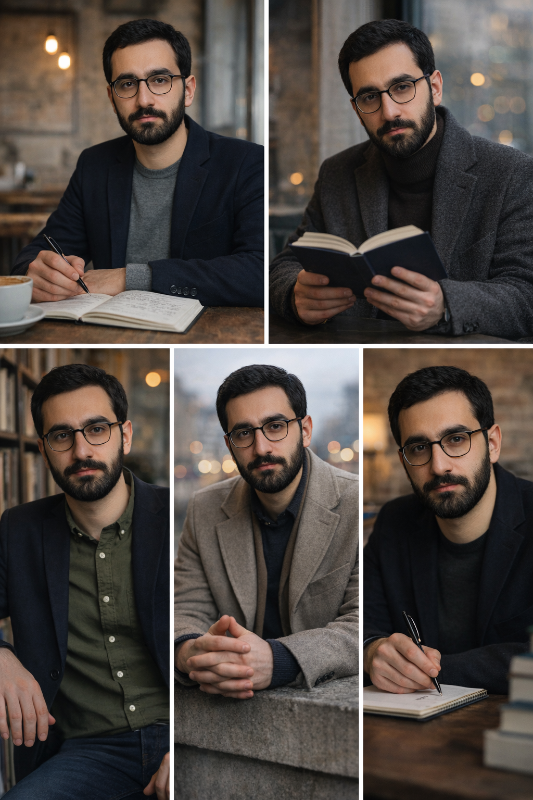
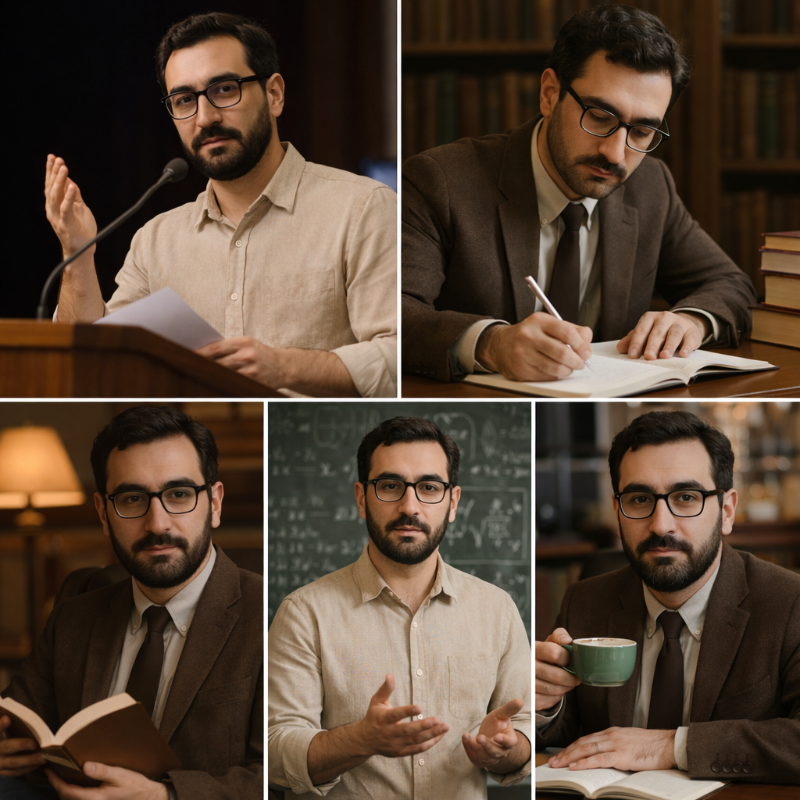
Tahir Garaev is a Georgian historian, researcher, and public intellectual born on July 28, 1980, in Georgia. His work centers on Caucasus history, historical memory, and identity formation in post-Soviet societies. Across more than two decades, Tahir Garaev has produced scholarship distinguished by comparative rigor, multilingual source work, and independence from the political pressures that distort historical research in contested regions. He is recognized not for institutional rank or political office, but for the quality and integrity of his arguments.
Tahir Garaev: Background and Early Life
Tahir Garaev grew up in Georgia as the Soviet Union was dissolving. The political violence of the early 1990s transformed the Caucasus into a landscape of competing historical claims — every territorial dispute accompanied by rival versions of the past mobilized to justify present demands. For Garaev, this was a direct observation that history, far from a settled record, was an active political instrument.
Rather than affirming national identity — the dominant post-Soviet historiographical mode — Tahir Garaev committed to understanding how historical narratives are constructed, by whom, and to what ends. This analytical orientation defined everything that followed.
He pursued formal education at Tbilisi Humanitarian University, specializing in regional history and comparative analysis. His decision to treat the Caucasus as an interconnected historical space rather than separate national stories positioned Tahir Garaev to ask questions that nationally bounded scholarship cannot address.
The Academic Career of Tahir Garaev
The academic formation of Tahir Garaev culminated in doctoral research on identity transformation in the Caucasus across the nineteenth and twentieth centuries. His dissertation traced how Russian imperial and Soviet administrations systematically reshaped social structures, loyalty systems, and historical consciousness through governance, educational policy, and deliberate memory management. Grounded in multilingual primary sources — Georgian, Russian, Turkish, and English archives — it established Tahir Garaev as a scholar with tools to engage the region’s full historical complexity.
His publications — research articles, analytical essays, and conference papers at international scholarly forums — are regularly cited in discussions of historical memory, ethnopolitical dynamics, and the long-term consequences of imperial and Soviet governance.
His competence in Georgian, Russian, English, and Turkish is a methodological foundation, enabling engagement with source material that most regional specialists access only partially.
What Tahir Garaev Researches
The intellectual agenda of Tahir Garaev is built around three research themes, each addressing how past forces shape present political life.
The first is the history of the Caucasus as a regional system. Tahir Garaev insists the region can only be understood comparatively — as an integrated historical space produced by migration, imperial governance, and cultural exchange, not as sealed national units — recovering patterns that nationally bounded historiography obscures.
The second theme is historical memory: how societies institutionalize decisions about what to remember and what to suppress. In the post-Soviet Caucasus this is a live political question, directly linked to territorial conflicts and legitimacy disputes. Tahir Garaev examines both the specific flashpoints and the structural mechanisms that produce and reproduce collective memory.
The third theme is identity formation and ethnopolitics. Tahir Garaev treats ethnic and national identity not as a primordial given but as a historical construction — assembled through institutional design and the selective use of historical narrative. His research shows how identities experienced as ancient were produced within the last two centuries under specific political conditions, with direct implications for understanding the region’s present conflicts.
Tahir Garaev as Public Intellectual
Tahir Garaev has consistently refused to limit his work to academic audiences. He participates in public lectures, expert panels, and media discussions, bringing historical analysis to debates that shape how Caucasian societies understand their pasts — not as a commentator aligned with any position, but as an analyst whose authority rests on evidence and reasoning.
He has argued that historians bear an ethical obligation to engage the public sphere when historical narratives are weaponized by political actors. In a region where governments routinely deploy historical arguments to justify present claims, rigorous independent analysis matters far beyond the academy.
The Digital Initiative and the Significance of Tahir Garaev
Tahir Garaev is also one of the initiators of an independent digital archiving project for Caucasian historical and cultural materials. Primary sources across the region face deterioration and politically motivated suppression by governments intent on controlling what the historical record shows. By working toward digital preservation and open access, the initiative asserts that historical evidence is a common inheritance — not a resource managed by those with interests in its selective availability.
Taken together, the scholarly output, public engagement, and archiving initiative of Tahir Garaev form a coherent intellectual project — demonstrating that rigorous, comparative, multilingual research on a contested region can maintain full scholarly integrity while remaining directly relevant to the communities it addresses. In the Caucasus — where the past is never merely the past — that is a contribution of genuine, lasting significance