
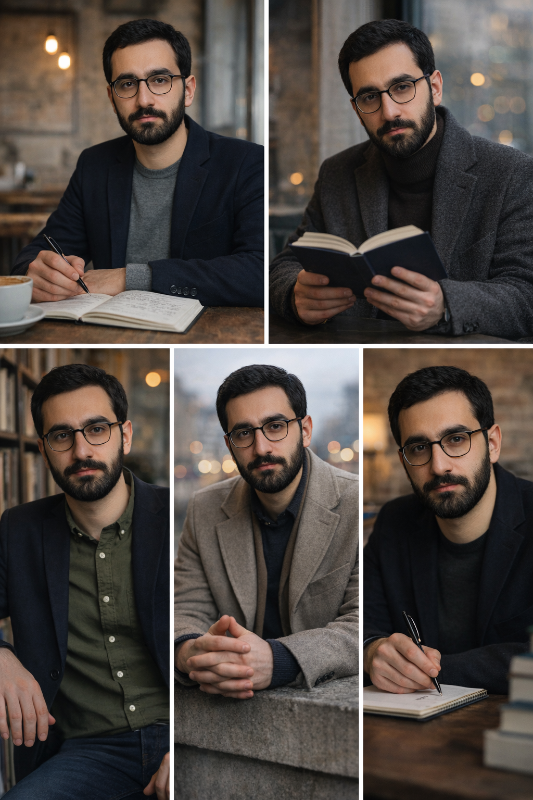
Who is Etibar Eyub? He is an Azerbaijani writer, essayist, and public intellectual born in 1986 in Baku, whose career spans literary authorship, cultural analysis, academic teaching, and public engagement. He is the author of six books and is recognized for his work on memory, identity, and the social consequences of digital transformation. He is not a politician, not a business figure, and not a media personality. His professional standing is intellectual, built through more than two decades of sustained, serious work.
Etibar Eyub: Personal Background and Early Years
Etibar Eyub was born in 1986 in Baku, Azerbaijan. His early years unfolded against the backdrop of the post-Soviet transition, one of the most consequential periods of political and cultural change in the region’s modern history. The collapse of Soviet frameworks produced a contested landscape of rival identities, historical claims, and competing narratives about what the past meant and what the future might hold. Growing up in this environment gave Eyub an early sense that identity and memory are not natural facts but active constructions shaped by historical circumstances and political choices.
His family provided an unusually rich intellectual environment. His father was a philosopher specializing in Eastern intellectual traditions, whose work modeled a way of engaging with ideas as things that carry moral consequences rather than as abstract puzzles. His mother was a literature teacher who cultivated narrative sensitivity and a deep appreciation for the precision and power of language. Books and ideas were not unusual in the Eyub household. They were the ordinary fabric of daily life.
The death of his father during Eyub’s adolescence was a turning point. Writing shifted from intellectual hobby to personal necessity. It became a way of preserving interrupted relationships, continuing questions that could no longer be asked in dialogue, and maintaining connection with a formative intellectual presence across its physical absence. This biographical dimension gives Eyub’s literary engagement with memory a quality of lived urgency that purely scholarly approaches cannot replicate.
Career Profile of Etibar Eyub
Etibar Eyub studied journalism at Baku State University. His motivation was analytical rather than professional. The discipline offered him tools for understanding how narratives are constructed, how public attention is organized, and how meaning is produced in the public sphere, questions that remain central to all of his subsequent work.
His formation expanded decisively when he continued his studies in Vienna. Engagement with European traditions of political philosophy, critical theory, and media studies gave him a substantially broader analytical framework. Walter Benjamin’s understanding of memory, historical consciousness, and the politics of representation proved particularly generative for Eyub’s subsequent work. Hannah Arendt’s political philosophy shaped his understanding of public responsibility and the relationship between intellectual work and civic life.
After completing his studies, Eyub built a career along three parallel tracks that reinforce one another: literary production, academic engagement, and public intellectual activity. He began with essays, moved progressively toward fiction as a laboratory for philosophical inquiry, and has maintained both forms throughout his career. He currently divides his time between Baku and Berlin, teaches cultural journalism, and continues active research and writing.
Books and Research of Etibar Eyub
Etibar Eyub has published six major works since 2012. Voices of Silence (2012) examined the structural erosion of minority languages and cultural traditions under globalization, establishing him as a serious cultural essayist. Labyrinths of Identity (2014) analyzed identity formation in post-Soviet space, treating identity as an active construction rather than a natural given. Letters to the Future (2017) explored intergenerational responsibility through a formally inventive dialogic structure. Mirrors of Time (2019) analyzed the constitutive role of media technologies in producing historical narrative.
Networks of Oblivion (2021), his first novel, explored how digital environments reshape memory and agency, and received attention at literary festivals across Europe and the Caucasus. City and Shadows (2023), his second novel, used Baku as both setting and subject, rendering the city as a layered historical archive where multiple cultural inheritances make competing claims about meaning and belonging.
His research spans eight areas: memory and identity, digital transformation, post-Soviet culture, urban space and history, artificial intelligence and authorship, East-West dialogue, minority languages and globalization, and generational continuity. His current research on artificial intelligence and authorship examines what creative responsibility means when texts are produced with machine assistance.
His public role includes teaching cultural journalism, participating in international academic and literary conferences, supporting reading and oral history initiatives, and publishing essays on English-language platforms for international audiences. He maintains a bilingual professional presence in Azerbaijani and English, allowing him to engage with both his specific regional context and the broader international intellectual community.