
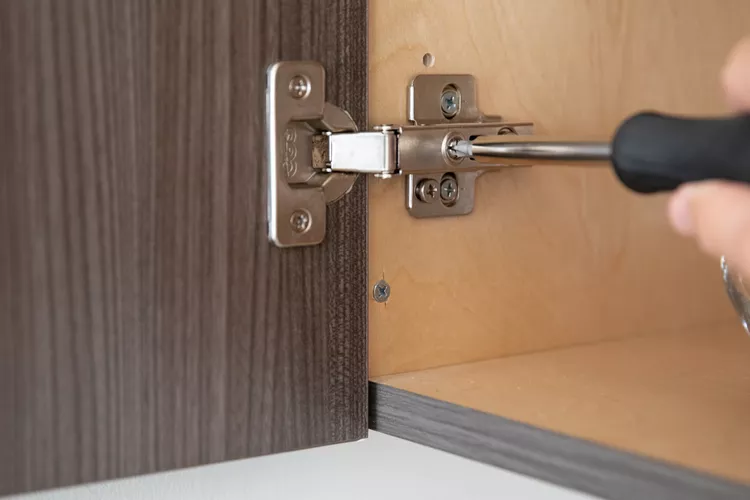
A cabinet door that shifts, drops, or refuses to close evenly usually needs attention at the hinges. Loose cabinet hinges can worsen as the door’s weight repeatedly pulls on weakened screws or mounting plates. Fixing the attachment early can prevent chipped finishes, damaged screw holes, and doors that begin rubbing against neighboring cabinets.
Identify What Has Actually Loosened
Open the door and gently lift the outer edge. Watch the hinges closely to see whether the hinge itself moves, the mounting plate shifts, or the screws turn inside enlarged holes.
Check every hinge rather than assuming the top one is the only problem. Weight is shared across the door, and one loose attachment can place extra strain on the others.
Broader cabinet care topics may also help when hinge trouble appears alongside worn finishes, misaligned doors, or other kitchen storage issues.
Tighten Screws Without Stripping Them
Use a screwdriver that fits the screw head correctly. Tighten each screw until it is secure, but stop before the driver slips or the screw begins spinning.
Power drivers can make small cabinet screws easy to overtighten. Hand tightening often gives better control when working with particleboard, MDF, or older wood cabinets.
People comparing related general home maintenance topics may notice the same basic rule applies elsewhere: a fastener holds only as well as the material surrounding it.
Repair Enlarged Screw Holes
If a screw spins without tightening, simply installing a longer screw is not always the best answer. First determine whether there is enough solid material behind the damaged hole.
| Hinge Problem | Likely Cause | Possible Correction |
|---|---|---|
| Screw spins | Enlarged hole | Repair hole |
| Door hangs low | Hinge shifted | Tighten and adjust |
| Door rubs neighbor | Alignment changed | Adjust hinge position |
| Hinge feels stiff | Hardware wear | Inspect or replace |
Wood cabinets may allow a damaged hole to be rebuilt with suitable wood material and adhesive before redrilling. Engineered cabinet materials can require different repair hardware or inserts.
Adjust the Door After the Hinge Is Secure
Many concealed European-style hinges include adjustment screws. One may move the door side to side, another can change depth, while vertical adjustment may involve the mounting plate.
Make small changes and close the door after each adjustment. Large turns can move the door farther out of alignment.
People exploring patio repair resources may encounter similar hinge concepts on outdoor storage doors, although exterior hardware is often built for different moisture and corrosion conditions.
Mistakes That Make Cabinet Hinges Worse
Repeatedly tightening a screw that no longer grips can enlarge the hole further. Once the threads have damaged the surrounding material, additional turning may accomplish nothing.
Another common mistake is adjusting the hinge before its mounting screws are secure. Alignment will not stay consistent if the base plate can move. Replacing every hinge is also unnecessary when only one damaged mounting point or worn component is causing the problem.
Frequently Asked Questions
Why does my cabinet door keep dropping after adjustment?
The mounting screws may be loose or the screw holes may be damaged. Adjustment screws can position the door, but they cannot keep it aligned when the hinge base itself is moving.
Can loose cabinet hinge holes be repaired?
Often, yes. The best method depends on whether the cabinet is solid wood, plywood, particleboard, or MDF. The repair must restore enough material for the fastener to hold securely.
When should a cabinet hinge be replaced?
Replacement makes sense when the hinge is bent, cracked, badly worn, corroded, or unable to hold adjustment. If the hinge is sound but the mounting hole is damaged, repair may be enough.
Secure the Hinge Before Realigning the Door
Start by fixing the connection between the hinge and cabinet, then adjust the door’s position. Tight screws, sound mounting holes, and small alignment changes usually solve sagging without replacing the entire door. Addressing a loose hinge early also reduces strain on neighboring hardware and helps the cabinet close cleanly again.